
Let's Peel
Blue Is the Warmest Color
Created by
PERFECT if
Perfect if you want to remember how first love feels before language catches up — how desire can both open and undo a life.
Style / Atmosphere
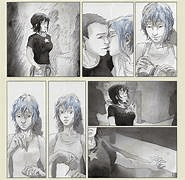
Ink washed in emotion. Muted greys and browns frame a pulse of electric blue — colour as heartbeat, as revelation, as truth too bright to hide.
Synopsis
“I don’t know if love is stronger than anything. But I know that nothing is stronger than the memory of it.”
Blue Is the Warmest Color tells the story of Clémentine, a teenager whose life shifts when she meets Emma, a confident art student with blue hair. Through their years together and apart, Maroh draws the body as diary — gestures, hesitations, and silences more eloquent than speech. The story is sensual but never voyeuristic; it aches with the knowledge that love is education, and heartbreak is its final exam.
Line Work
Fine ink outlines, cross-hatched restraint, and a cool blue wash give each frame the stillness of archival memory. The geometry comforts and confines — a hand trying to stay steady while remembering trembles.
The pacing
Carefully measured. Each panel holds its breath. Page turns feel like walking through long hallways: you sense the echo before the sound. Time folds in on itself — moments revisited from multiple angles until they align.
The Voice
Bechdel’s narration overlays the images like transparent vellum — analytical, ironic, tender. Text and image never mirror; they negotiate. Where her voice retreats, her drawings lean closer.
From Page
to Screen
Fun Home: A New Broadway Musical (2013, dir. Sam Gold) — a stage adaptation that turns Bechdel’s visual silence into song.
The comic’s symmetrical structure and literary layering influenced how Call Me by Your Name (2017, dir. Luca Guadagnino) and The Father (2020, dir. Florian Zeller) visualise memory as architecture — intimate rooms echoing with withheld truths.

Peel me a Book

Let's Peel
Blue Is the Warmest Color
Created by
Style / Atmosphere
Ink washed in emotion. Muted greys and browns frame a pulse of electric blue — colour as heartbeat, as revelation, as truth too bright to hide.
Perfect if
Perfect if you want to remember how first love feels before language catches up — how desire can both open and undo a life.
Synopsis
“I don’t know if love is stronger than anything. But I know that nothing is stronger than the memory of it.”
Blue Is the Warmest Color tells the story of Clémentine, a teenager whose life shifts when she meets Emma, a confident art student with blue hair. Through their years together and apart, Maroh draws the body as diary — gestures, hesitations, and silences more eloquent than speech. The story is sensual but never voyeuristic; it aches with the knowledge that love is education, and heartbreak is its final exam.
Line Work
Soft pencils layered with watercolour. The world exists in warm monochrome until love enters — blue bleeds in slowly, tinting skin, sky, and thought. When it disappears, the colour lingers like afterimage.
The pacing
Tender and rhythmic. Panels follow the rhythm of a breath — anticipation, closeness, retreat. Maroh controls time through touch; a hand brushing hair lasts longer than years passing.
The Voice
Intimate and retrospective. Told through letters, confessions, and memories, the voice feels like a heartbeat speaking to itself. Maroh’s empathy turns personal pain into shared understanding.
From Page
to Screen
Blue Is the Warmest Color (2013, dir. Abdellatif Kechiche) — Palme d’Or winner at Cannes; controversial for its explicitness but faithful to the novel’s emotional core.
Its visual candour and emotional vulnerability echo through Portrait of a Lady on Fire (2019, dir. Céline Sciamma) and Call Me by Your Name (2017, dir. Luca Guadagnino) — films where intimacy becomes transcendence.