
Let's Peel
The Property
Created by
PERFECT if
Perfect if you want to see how history lingers in the spaces between generations; how love, shame, and property deeds all demand translation.
Style / Atmosphere
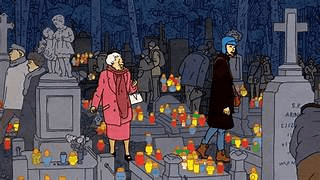
Elegant clarity hiding sharp emotion. Modan’s ligne-claire drawing—clean contours, flat colour, open white—turns grief and bureaucracy into gentle comedy. Beneath the polish, it’s a book about inheritance: of land, of silence, of memory.
Synopsis
“We travel to find what was lost, only to learn it never really belonged to us.”
An Israeli granddaughter accompanies her grandmother to Warsaw to reclaim a family apartment lost during the war. What begins as legal errand becomes an excavation of secrets: affection and betrayal tangled with ancestry.
Modan sketches conflict not through soldiers but through manners—humour, irritation, the small awkward mercies of family travel.
Line Work
Fine ink outlines, cross-hatched restraint, and a cool blue wash give each frame the stillness of archival memory. The geometry comforts and confines — a hand trying to stay steady while remembering trembles.
The pacing
Carefully measured. Each panel holds its breath. Page turns feel like walking through long hallways: you sense the echo before the sound. Time folds in on itself — moments revisited from multiple angles until they align.
The Voice
Bechdel’s narration overlays the images like transparent vellum — analytical, ironic, tender. Text and image never mirror; they negotiate. Where her voice retreats, her drawings lean closer.
From Page
to Screen
Fun Home: A New Broadway Musical (2013, dir. Sam Gold) — a stage adaptation that turns Bechdel’s visual silence into song.
The comic’s symmetrical structure and literary layering influenced how Call Me by Your Name (2017, dir. Luca Guadagnino) and The Father (2020, dir. Florian Zeller) visualise memory as architecture — intimate rooms echoing with withheld truths.

Peel me a Book
Let's Peel
The Property
Created by
Style / Atmosphere
Elegant clarity hiding sharp emotion. Modan’s ligne-claire drawing—clean contours, flat colour, open white—turns grief and bureaucracy into gentle comedy. Beneath the polish, it’s a book about inheritance: of land, of silence, of memory.
Perfect if
Perfect if you want to see how history lingers in the spaces between generations; how love, shame, and property deeds all demand translation.
Synopsis
“We travel to find what was lost, only to learn it never really belonged to us.”
An Israeli granddaughter accompanies her grandmother to Warsaw to reclaim a family apartment lost during the war. What begins as legal errand becomes an excavation of secrets: affection and betrayal tangled with ancestry.
Modan sketches conflict not through soldiers but through manners—humour, irritation, the small awkward mercies of family travel.
Line Work
Clean outlines and rich colour blocks. Influenced by European bande dessinée, each panel feels sun-lit even when speaking of ghosts. The brightness keeps sorrow legible, never sentimental.
The pacing
Conversational, cinematic.
Scenes flow like film cuts—train windows, airports, hotel lobbies. Moments of stillness land softly, then move on; Modan edits with empathy.
The Voice
Witty, restrained, emotionally precise. Dialogue overlaps like real talk: affection mixed with irritation. Modan lets humour carry heartbreak; irony becomes tenderness.
From Page
to Screen
No film adaptation yet, though Modan’s visual tone echoes in The Kind Words (2015, dir. Shemi Zarhin) and Foxtrot (2017, dir. Samuel Maoz): stories where family journeys reveal national fault lines.
Her colour sensibility and humane irony parallel Marjane Satrapi’s Persepolis—a different geography, a shared belief in personal witness.