
Let's Peel
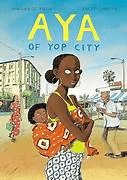
Aya of Yop City
Created by
PERFECT if
Perfect if you want to feel daily life pulse through panels — friendship, ambition, and humour instead of despair.
Style / Atmosphere
Sunlight in ink. Bright colours, generous faces, and laughter that carries over the hum of 1970s Abidjan. Abouet and Oubrerie capture community with affection — drama, gossip, music, and dreams all drawn in warm lines.
Synopsis
“The heat was everywhere, but so was the music. Even problems had a rhythm.”
Set in Yopougon, a working-class neighbourhood of Abidjan, Aya follows three young women navigating family, love, and independence. It’s a soap opera and a social document at once — a portrait of an African city rarely shown through joy. The energy is infectious: panels packed with chatter, hair salons, radio jingles, and quiet moments of self-discovery.
Line Work
Fine ink outlines, cross-hatched restraint, and a cool blue wash give each frame the stillness of archival memory. The geometry comforts and confines — a hand trying to stay steady while remembering trembles.
The pacing
Carefully measured. Each panel holds its breath. Page turns feel like walking through long hallways: you sense the echo before the sound. Time folds in on itself — moments revisited from multiple angles until they align.
The Voice
Bechdel’s narration overlays the images like transparent vellum — analytical, ironic, tender. Text and image never mirror; they negotiate. Where her voice retreats, her drawings lean closer.
From Page
to Screen
Fun Home: A New Broadway Musical (2013, dir. Sam Gold) — a stage adaptation that turns Bechdel’s visual silence into song.
The comic’s symmetrical structure and literary layering influenced how Call Me by Your Name (2017, dir. Luca Guadagnino) and The Father (2020, dir. Florian Zeller) visualise memory as architecture — intimate rooms echoing with withheld truths.

Peel me a Book

Let's Peel
Aya of Yop City
Created by
Style / Atmosphere
Sunlight in ink. Bright colours, generous faces, and laughter that carries over the hum of 1970s Abidjan. Abouet and Oubrerie capture community with affection — drama, gossip, music, and dreams all drawn in warm lines.
Perfect if
Perfect if you want to feel daily life pulse through panels — friendship, ambition, and humour instead of despair.
Synopsis
“The heat was everywhere, but so was the music. Even problems had a rhythm.”
Set in Yopougon, a working-class neighbourhood of Abidjan, Aya follows three young women navigating family, love, and independence. It’s a soap opera and a social document at once — a portrait of an African city rarely shown through joy. The energy is infectious: panels packed with chatter, hair salons, radio jingles, and quiet moments of self-discovery.
Line Work
Expressive and lively. Oubrerie’s lines are fluid, slightly exaggerated, animated by a palette of ochre, teal, and rose. Every page feels like sunlight filtered through cotton
The pacing
Quick, rhythmic, cinematic. Scenes tumble into each other like neighbourhood gossip; yet moments of intimacy — a glance, a sigh, a quiet evening — slow the pulse just enough to stay human.
The Voice
Warm, humorous, unapologetically local. Abouet writes with affection for her city and its people — no exoticism, no pity. The dialogue sings; the narration trusts the reader to keep up with its rhythm.
From Page
to Screen
Aya of Yop City (2013, dir. Marguerite Abouet & Clément Oubrerie) — animated adaptation retaining the same joy and colour, nominated for César and Annecy awards.
Its communal energy and tender humour echo in Rafiki (2018, dir. Wanuri Kahiu) and Barakah Meets Barakah (2016, dir. Mahmoud Sabbagh) — films where laughter and rebellion share the same heart.